Today, I thought I’d talk about Business Intelligence (BI) as a whole. This area of IT has evolved so much in such a short period of time, growing and branching to different and new disciplines that are created due to the need to interpret and leverage the data in the modern world. The rapid growth makes it one of the most demanded domains in the current world, that’s why I think it is very relevant to talk about what BI is becoming and where you can fit in.
Let’s back up a little bit and start from the beginning: what exactly is business intelligence? It is understood today to be the use of technology to gather and analyse data to provide useful and actionable information. The modern version of BI we practice today is focused on using technology to find the right data at the right time to generate valuable information quickly and efficiently.
The increasing need to collect and interpret data has been the key component for this industry’s expansion. Now more than ever companies understand that using meaningful insights is an effective approach to win over competitors and grow their businesses. One of the biggest obstacles to leverage this useful approach is the collection of messy data, that makes real-time analysis very difficult. Business Intelligence is the solution to this problem, with the right implementation of technology you can make real-time analysis of data a reality.
The transformation of BI over the last 30 years has taken the value of data to a new level. Data used to be something we kept as history with the purpose of auditing or examining previous actions taken by the users of an application or system. When we understood the potential of leveraging this information, BI started to change. Back in the late 1990s and early 2000s, BI services began providing simplified tools, creating a user-friendly interface that allows decision-makers to become more self-sufficient.
Today, these tools are easier to use, and provide a lot of functionality that results in effective outcomes. However, to get to this point there are a lot of things that need to happen behind the scenes, so let’s talk about of the team roles and responsibilities involved to understand a little bit more of the process:
- Database administrator: Designing, loading and monitoring the databases
- Data Analyst: Interprets and understands the data the team is working with. Finds correlations, patterns or weaknesses to be explored in the data.
- Business Analyst: Leads modelling sessions, provides data definitions, writes test cases, makes business decisions, and improves the data quality.
- Data Modeller: Designs and develops the semantic layer, consisting of defining the hierarchies and relationships between data entities and attributes used in reporting. This can include the design of the data mart relational schema.
- ETL Developer: Develops the packages and database objects used to load data from source systems into staging tables and transforms data into data mart structures.
- Infrastructure Architect: Designs and implements information systems to support the enterprise infrastructure of an organization. They ensure that all systems are working at optimal levels and support the development of new technologies and system requirements.
- Report/dashboard developer: Develops, deploys and maintains data visualisations, those include static and dynamic reports and interactive dashboards, ad hoc reporting, queries and data modelling tools.
- Testers: Testing and checking the data quality and code created by developers to get to the final outcome.
- Data scientist: Collect, transform, analyse and interpret large dataset to determine trends, patterns and obtain predictive insights.
- Data owner: A Data Owner has administrative control and has been officially designated as accountable for a specific information asset dataset. Data owners approve data glossaries and definitions as well as initiate data quality activities.
- Project Manager: The Project Manager contributes to technical management and communications as well as customer satisfaction and implementation success of a project. The Project Manager is responsible for timely deliverables, project staffing, and overall satisfaction of the customer.
- Technical and Non-Technical Users: Users that are involved in the development and implementation process usually have a place in the team and act as a data analyst or business analyst to contribute and guide the team to develop a successful BI project.
Each project, team and organisation is unique, the roles in the team will vary depending on the specific needs of the work required. On many occasions, one person might play two or more roles, as this is completely acceptable if the scope of the project allows it.
Now let’s touch on what type of work is implemented in the BI space. We have different types of analytics to obtain meaningful insights, and the decision of what is best for you will depend on the questions you need to answer as well as what data, architecture, technology and human resources are available to you and your company. A brief description of the type of analytics and how they are used today:
Descriptive Analytics
Used most likely to study the past. This type of analytics describes and summarises data. The major takeaways from this type of analysis are the impact of past behaviour in the present.
Predictive Analytics
Used to provide information on what the future might look like. This type of analytics uses statistical models to anticipate upcoming changes. Mainly focused on identifying trends, patterns, correlations and forecasting behaviours.
Prescriptive Analytics
Used to provide advice based on predicting future outcomes. This type of analytics is focused on predicting the impact of different actions and assess the best way to proceed. The premise is that you’ll be able to know what will happen and advise the best case scenario from that information.
Streaming Analytics
Used to know what is happening at any given time and taking actions as soon as possible. This type of analytics is referred to as real-time analytics because the premise is that it is constantly calculating, reprocessing and providing information to act upon.
Now that we got the concepts out of the way, let’s talk about the future of BI. A market analysis of the BI software industry by Grand View Research company has shown consistent growth over the last few years and the prospects for years to come is very promising:
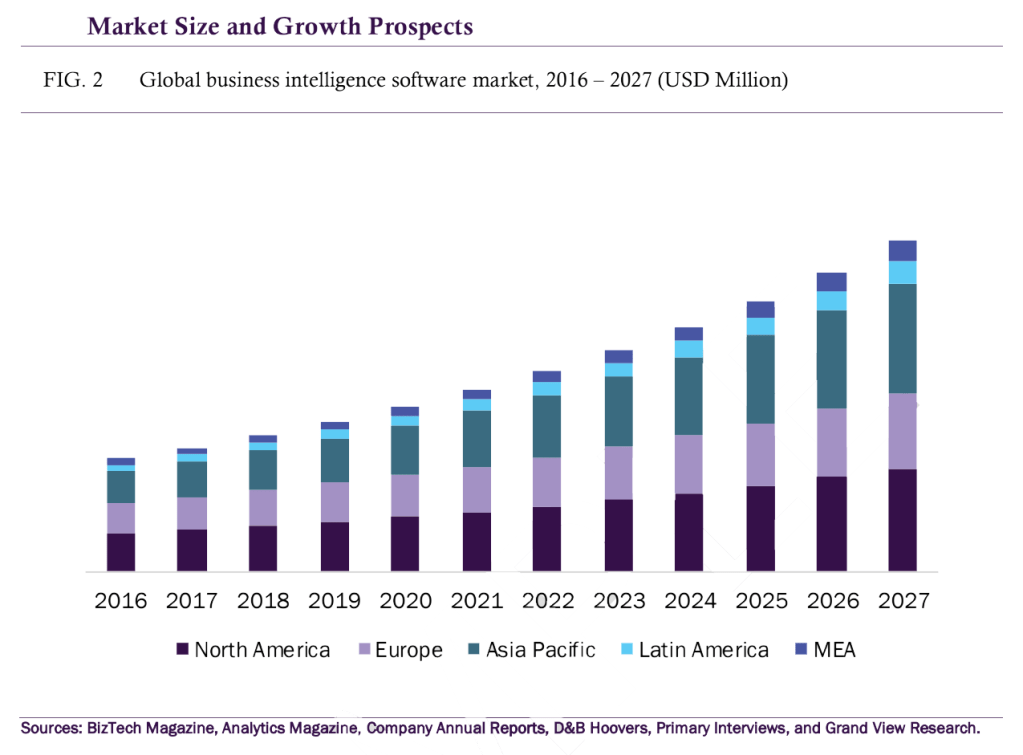
The increasing demand for business intelligence solutions in the cloud is driving the market. Employment growth in this industry has been very strong. In 2008, the output from the data processing and hosting industry totalled $87.8 billion. By 2018, that amount had more than doubled to $205.9 billion. Over the next 10 years, industry output is projected to exceed $280 billion.
It’s important to understand that the BI market has major software companies that are leading the development of tools that make it easier to implement solutions for data analysis. The tool and platform they are developing have had a big impact on market growth over the last decade. As we can see in the following chart, Microsoft and Tableau are, by far, the leaders and major players:

By creating a framework where insights become a vital part of the decision-making process to determine a company’s future, BI is gaining strength and always innovating to become more accurate, make business operations smarter and give a competitive edge.
If you were ever considering a career in BI, this is the best moment to do it. With the ever-changing and rapid expansion of this field, more professionals are required to learn and specialise in BI tasks, which creates amazing opportunities for people to learn new technology, methodologies and become an indispensable part of a BI team. From developing software, creating reports to planning projects, BI spans across a broad array of job roles which require diverse skills. In BI, the phrase “practice makes perfect” is completely true, even though the concepts and the theoretical knowledge is very important, doing the work is what actually teaches you to be good in BI. There will be always more than one implementation solution for a project, and the best way to find the right approach is practice!
There are a lot of good courses and tutorials completely free online to get involved in this area, look for areas that interest you and start creating your own projects!
REFERENCES
https://intellipaat.com/blog/business-intelligence-best-career-option-2019/
 Tidemark @ RisingTide.Tech
Really impressed! Everything is very open and very clear clarification of issues. It contains truly facts. Your website is very valuable. Thanks for sharing.digital marketing course in Vijayawada
LikeLike
[…] my last post, I covered the subject of what BI is and where is headed, I thought on this one I could dig a bit deeper by talking about the specific’s terminologies and […]
LikeLike